Introduction
Abanindranath Tagore (7 August 1871 – 5 December 1951) was one of the most influential artists in the history of Indian art. He is widely regarded as the founder and leading figure of the Bengal School of Art, a movement that sought to develop a distinctly Indian style of painting during the British colonial period. Through his paintings, writings, and teaching, Abanindranath played a major role in the revival of traditional Indian artistic heritage and helped shape the course of modern Indian art.
Early Life and Family Background
Abanindranath Tagore was born on 7 August 1871 at the Jorasanko Thakur Bari in Calcutta (now Kolkata), Bengal Presidency, British India. He belonged to the renowned Tagore family, which made significant contributions to Indian literature, music, art, and culture.
His father was Gunendranath Tagore, and his mother was Saudamini Devi. He was the nephew of the Nobel Prize-winning poet Rabindranath Tagore and the younger brother of artist Gaganendranath Tagore. Growing up in a culturally rich environment, Abanindranath was exposed to literature, music, theatre, and art from an early age.
Education
Abanindranath received his early education at Sanskrit College in Calcutta and later attended St. Xavier’s College. Although he did not receive formal academic training in art during his early years, he developed a strong interest in drawing and painting.
He initially studied European academic painting under Italian artist Signor Gilhardi and British artist Charles Palmer. However, he later became dissatisfied with Western academic methods and began exploring traditional Indian artistic traditions.
Artistic Beginnings
Abanindranath Tagore’s artistic journey began during a period when Western academic art dominated art education in India. In the late nineteenth century, British colonial institutions encouraged artists to follow European methods of painting, emphasizing realism, perspective, anatomy, and oil painting techniques. Like many young artists of his time, Abanindranath initially received training in these Western academic styles.
He studied drawing and painting under the Italian artist Signor Gilhardi and later under the British artist Charles Palmer. Through this training, he learned the principles of European academic art, including realistic representation, shading, perspective, and composition. His early works reflected the influence of these techniques and demonstrated his strong technical abilities.
However, despite mastering European methods, Abanindranath gradually felt that they did not fully express India’s cultural identity and artistic traditions. He became increasingly interested in discovering an artistic language that reflected the history, spirituality, and aesthetics of India rather than simply imitating Western models.
A major turning point in his artistic development came in the 1890s when he met Ernest Binfield Havell (E. B. Havell), the Principal of the Government School of Art in Calcutta. Havell strongly believed that Indian art possessed a rich and distinctive heritage that deserved recognition and preservation. He encouraged students and artists to study traditional Indian painting instead of relying exclusively on European academic practices.
Under Havell’s influence, Abanindranath began exploring the artistic traditions of Mughal, Rajput, and Pahari miniature paintings. He carefully studied their delicate brushwork, graceful compositions, symbolic imagery, and subtle use of colour. These traditional Indian paintings offered a completely different artistic approach from the realism of European art. Rather than focusing on exact physical representation, they emphasized mood, emotion, spirituality, and storytelling.
At the same time, Abanindranath became interested in India’s cultural and historical heritage. He studied ancient Indian literature, mythology, religious texts, and historical narratives, which later became important sources of inspiration for his paintings. This growing appreciation for Indian traditions coincided with the rise of nationalist sentiments in colonial India, encouraging many intellectuals and artists to seek a stronger cultural identity.
Another important influence on Abanindranath’s early artistic development was his exposure to Japanese art and aesthetics. Around the beginning of the twentieth century, he came into contact with Japanese thinkers and artists such as Okakura Kakuzō (Tenshin), Yokoyama Taikan, and Hishida Shunsō. Through these interactions, he learned the Japanese wash technique, which used delicate layers of transparent colour to create soft, atmospheric effects. He successfully combined these techniques with Indian artistic traditions, creating a distinctive style that became one of the defining features of the Bengal School of Art.
During this formative period, Abanindranath produced several important paintings that reflected his search for a new artistic identity. Works such as Krishna Lila, The Passing of Shah Jahan, and later Bharat Mata demonstrated his departure from Western realism and his commitment to Indian themes, history, and spirituality.
By the early twentieth century, Abanindranath had emerged as a leading advocate for the revival of Indian art. His artistic experiments and research into traditional Indian aesthetics laid the foundation for the Bengal School of Art, which became the first major modern art movement in India. Through his efforts, he inspired a generation of artists to value India’s artistic heritage and develop a national style of painting rooted in Indian culture and traditions.
Bengal School of Art
The development of the Bengal School of Art was one of the most significant events in the history of modern Indian art. At the end of the nineteenth century, art education in India was largely controlled by British colonial institutions. Students were trained in European academic methods that emphasized realism, perspective, anatomy, and oil painting. While these techniques were highly valued, many Indian artists and intellectuals felt that they did not reflect India’s cultural identity, artistic traditions, or spiritual values.
Against this background, Abanindranath Tagore emerged as a leading figure in the search for a distinctly Indian artistic expression. His efforts, together with those of E. B. Havell, led to the formation of what later became known as the Bengal School of Art.
Famous Works
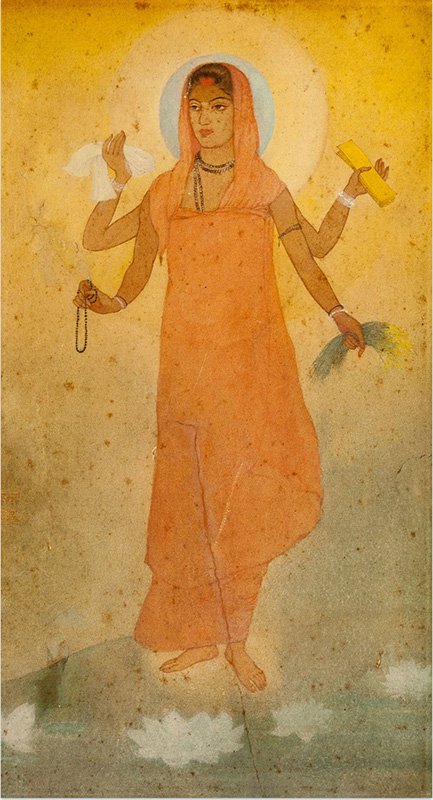
Bharat Mata (Mother India), painted in 1905 by Abanindranath Tagore, is one of the most iconic works in the history of modern Indian art. Created during the Swadeshi Movement following the Partition of Bengal, the painting became a powerful symbol of Indian nationalism and cultural identity.
The artwork depicts a young woman representing Mother India. She is dressed in a simple saffron robe, symbolizing sacrifice, spirituality, and devotion. Unlike traditional depictions of goddesses, Bharat Mata appears calm, humble, and compassionate. She has four arms, a feature inspired by Indian religious iconography, representing her divine and nurturing qualities.
In her four hands, she holds a book, sheaves of paddy, a white cloth, and a rosary (mala). These objects symbolize the essential foundations of the nation: knowledge and education, food and prosperity, economic self-reliance, and spiritual strength. Together, they express Abanindranath’s vision of a strong and self-sufficient India rooted in both material progress and moral values.
The painting is a masterpiece of the Bengal School of Art, which sought to revive traditional Indian artistic styles as an alternative to Western academic art. Abanindranath used soft colours, delicate brushwork, and the Japanese-inspired wash technique to create a peaceful and spiritual atmosphere.
Bharat Mata is significant not only for its artistic excellence but also for its cultural and political impact. It transformed the idea of India into a human and maternal figure, inspiring patriotism and national pride during the freedom movement. Today, it remains one of the most influential paintings in Indian art history and a lasting symbol of India’s cultural renaissance.
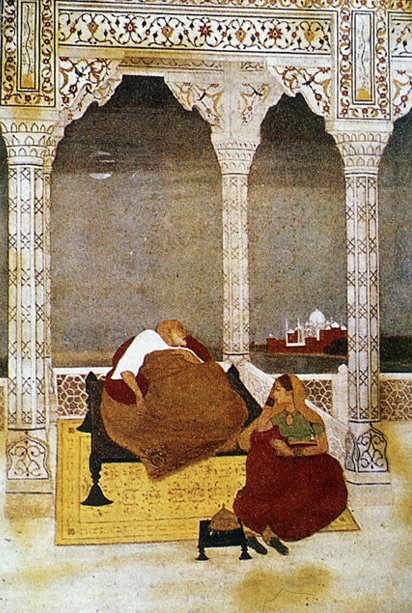
The Passing of Shah Jahan (c. 1902) is one of the most celebrated paintings by Abanindranath Tagore and a masterpiece of the Bengal School of Art. The painting depicts the final days of the Mughal Emperor Shah Jahan, who was imprisoned in the Agra Fort by his son Aurangzeb. From his chamber, the aging emperor gazes toward the Taj Mahal, the magnificent monument he built in memory of his beloved wife, Mumtaz Mahal.
The artwork captures a deeply emotional moment. Shah Jahan is shown lying weak and ill on his deathbed, accompanied by his devoted daughter Jahanara Begum. Through subtle expressions and a quiet atmosphere, Abanindranath conveys the emperor’s loneliness, sorrow, and longing. The distant view of the Taj Mahal symbolizes both his love for Mumtaz and the memories of a glorious past that he can no longer reclaim.
The painting reflects Abanindranath’s interest in Indian history and his desire to create art rooted in Indian themes rather than Western subjects. Influenced by Mughal miniature paintings, he used soft colours, delicate brushwork, and gentle shading to create a poetic and melancholic mood. The composition focuses on emotion rather than dramatic action, making the viewer feel the emperor’s personal tragedy.
The Passing of Shah Jahan is widely regarded as one of Abanindranath Tagore’s finest achievements because of its emotional depth, historical significance, and artistic refinement. It demonstrates the core ideals of the Bengal School of Art—simplicity, spirituality, and emotional expression. Today, the painting remains an important landmark in Indian art history and is admired for its sensitive portrayal of one of the most poignant moments in Mughal history.
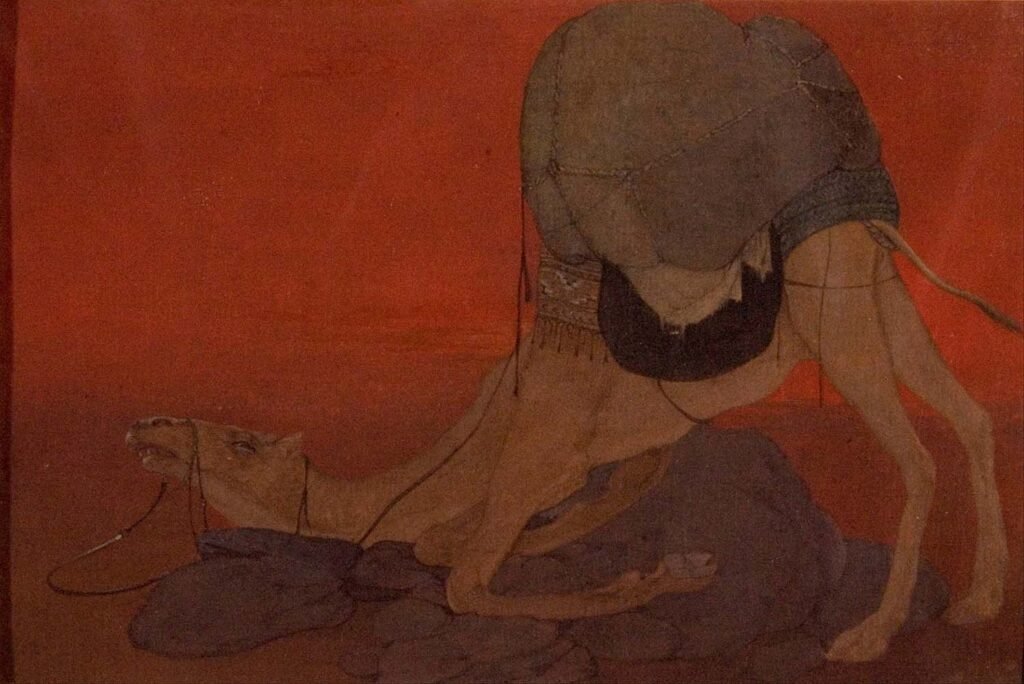
Journey’s End (1913) is one of the most celebrated paintings by Abanindranath Tagore and a masterpiece of the Bengal School of Art. The painting portrays a tired camel collapsing at the end of a long journey beneath the setting sun. Though simple in composition, the artwork conveys profound emotions of exhaustion, endurance, and the inevitable end of a journey.
Abanindranath employed the wash technique, a method influenced by Japanese painting traditions and adapted within the Bengal School. This technique involves applying multiple transparent layers of watercolour to create soft tonal transitions, delicate shading, and a dreamlike atmosphere. The artist avoided strong outlines and excessive detail, allowing mood and emotion to dominate the composition.
The painting’s subdued colour palette, gentle brushwork, and atmospheric effects create a sense of silence and reflection. The setting sun enhances the melancholic mood and symbolizes completion, rest, and the passage of time. The exhausted camel is often interpreted as a metaphor for the struggles of human life and the burdens carried throughout one’s journey.
Unlike Western academic realism, which emphasizes precise physical details, Abanindranath focused on emotional expression and symbolic meaning. His use of the wash technique gives the painting a poetic quality that is characteristic of the Bengal School.
Journey’s End is admired for its simplicity, emotional depth, and technical refinement. Through delicate watercolour washes and subtle composition, Abanindranath transformed an ordinary scene into a powerful meditation on perseverance, fatigue, and the end of life’s journey. Today, it remains one of the most iconic works in the history of modern Indian art.