
Biography
Early Life and Artistic Beginnings
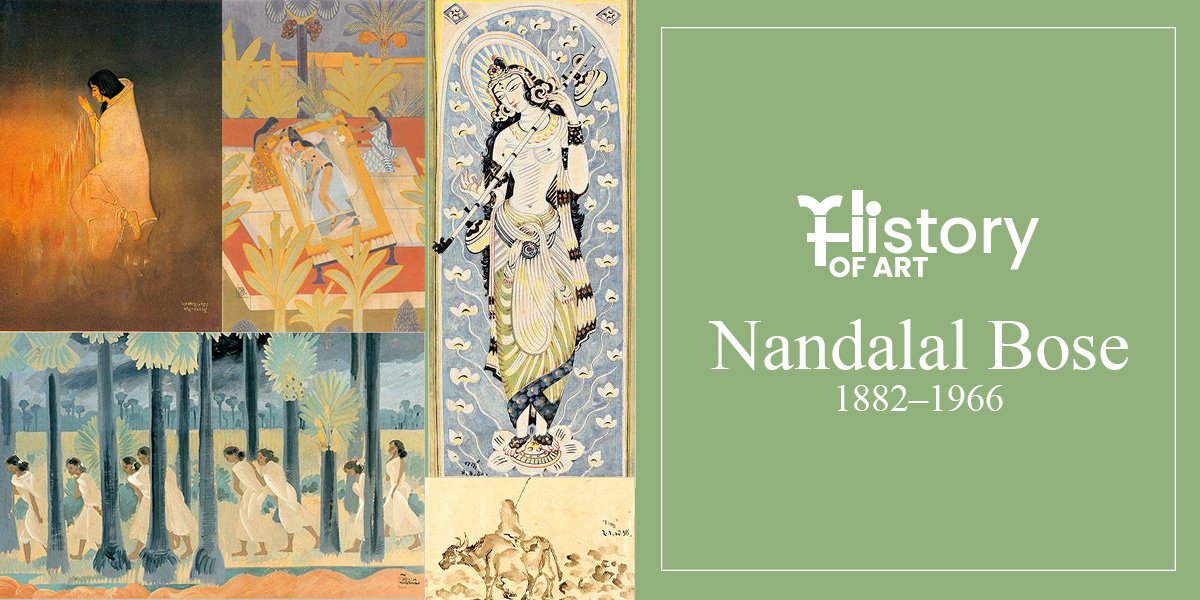
Nandalal Bose (1882–1966) was one of the most influential figures in modern Indian art and a leading artist of the Bengal School. Through his paintings, murals, prints, and educational work, he played a vital role in reviving Indian artistic traditions during the colonial period and helped shape a distinctly Indian visual identity. He was born on 3 December 1882 in Kharagpur, Munger District (present-day Bihar), India. His father, Purnachandra Bose, worked in the Darbhanga estate, while his mother, Kshetramoni Devi, was skilled in traditional crafts and encouraged his artistic interests from an early age. As a child, Bose was fascinated by nature, village life, and the work of local artisans who made clay toys, masks, and decorative objects. These early experiences left a lasting impression on his artistic vision and later became important sources of inspiration in his work.
Education and Artistic Development
After moving to Calcutta (Kolkata) for higher education, Bose initially followed conventional academic studies. However, his passion for art led him to enroll at the Government School of Art, Calcutta, where he studied under Abanindranath Tagore, the founder of the Bengal School of Art. Under Tagore’s guidance, Bose developed a deep appreciation for Indian artistic traditions and became part of a movement that challenged the dominance of European academic styles in colonial India. A major turning point in his career came in 1909, when he joined Lady Christiana Herringham’s project to copy the ancient murals of the Ajanta Caves in Maharashtra. This experience exposed him to one of India’s greatest artistic achievements and profoundly influenced his understanding of line, form, colour, and composition. Inspired by Ajanta, as well as Mughal and Rajput miniature paintings, Bose gradually developed a distinctive artistic language rooted in Indian traditions.
Santiniketan and Art Education
Nandalal Bose’s association with Rabindranath Tagore and the cultural movement at Santiniketan became central to his life and career. In 1921, he joined Kala Bhavana, the art school of Visva-Bharati University, and later became its principal. At Santiniketan, he developed an innovative educational philosophy that encouraged students to learn from nature, traditional Indian arts, village crafts, and direct observation rather than merely copying academic models. His approach transformed art education in India and helped create an environment where creativity, cultural awareness, and experimentation could flourish. During this period, Bose also travelled extensively within India and abroad, visiting countries such as China, Japan, Burma (Myanmar), and Sri Lanka. These travels broadened his artistic outlook while reinforcing his commitment to Indian cultural values and Asian artistic traditions.
National Contribution and Artistic Legacy
Beyond his achievements as an artist and educator, Bose played an important role in India’s cultural and nationalist movement. At the invitation of Mahatma Gandhi, he designed and supervised artistic decorations for several sessions of the Indian National Congress, including the famous Haripura Session of 1938. His posters and visual designs celebrated ordinary Indian people, rural life, and indigenous culture, reflecting the ideals of the freedom movement. One of his most significant contributions was the decoration of the original handwritten Constitution of India, for which he and his students created illustrations inspired by Indian history, mythology, and cultural heritage. Throughout his career, Bose worked in a variety of media including watercolor, tempera, wash painting, linocuts, murals, and drawings. Influenced by Ajanta murals, Indian miniature paintings, East Asian brush traditions, folk art, and everyday life, he created a vast and influential body of work. Nandalal Bose passed away on 16 April 1966 in Santiniketan, West Bengal, but his legacy continues to inspire artists, scholars, and students. Through his work and teaching, he helped establish a modern Indian artistic identity rooted in indigenous traditions while remaining open to innovation and creative exploration.
Famous Works
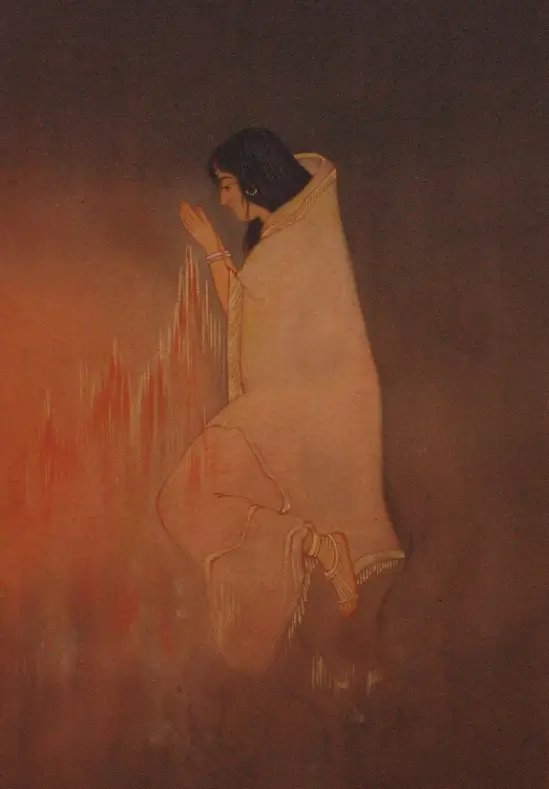
Sati (1907) is one of Nandalal Bose’s earliest and most significant paintings. The work reflects the influence of Indian artistic traditions, Japanese wash techniques, and the ideals of the Bengal School of Art. Bose incorporated artistic methods and visual approaches that he learned through the works and guidance of Rabindranath Tagore and Abanindranath Tagore, particularly the delicate wash technique and the aesthetic principles of Indian miniature painting. It depicts the legendary Hindu practice of sati, in which a widow was believed to sacrifice herself on her husband’s funeral pyre. Rather than presenting the event as a historical narrative, Bose focused on its emotional and symbolic dimensions, portraying a solemn figure that conveys sacrifice, grief, and inner strength.
The painting demonstrates Bose’s mastery of transparent layers of color and delicate brushwork. By combining Indian miniature traditions with Japanese wash-painting techniques, he created a contemplative and poetic image that remains an important landmark in his early artistic career.
Date: 1907
Subject: A widow preparing for sati in Hindu tradition
Theme: Sacrifice, dignity, sorrow, and spiritual transcendence
Style: Bengal School of Art, incorporating wash technique and Indian miniature aesthetics.
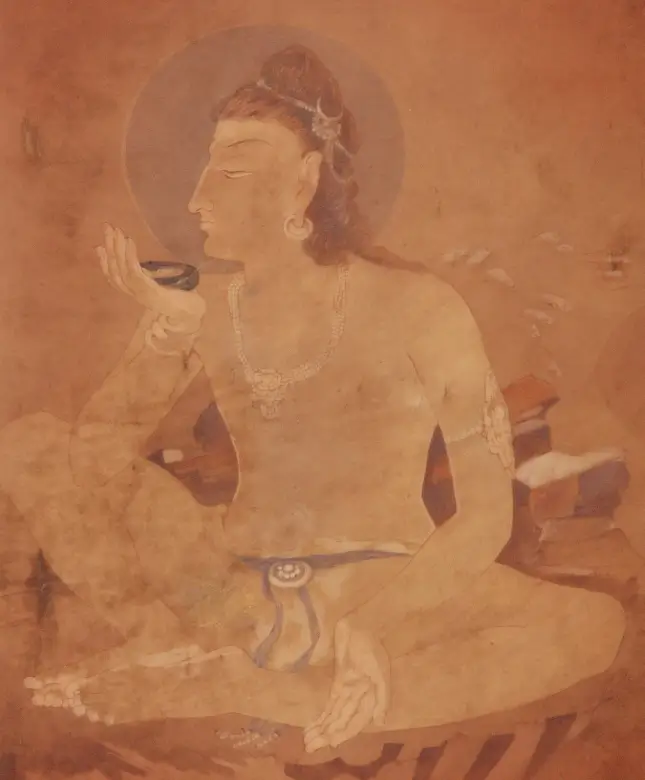
Shiva Drinking the World Poison is one of Nandalal Bose’s notable mythological paintings, inspired by the Hindu story of Samudra Manthana (the Churning of the Ocean). According to the legend, a deadly poison (halahala) emerged during the churning process, threatening to destroy the universe. To save all living beings, Lord Shiva drank the poison and held it in his throat, which turned blue and earned him the name Neelkantha (“the Blue-Throated One”).
In this painting, Bose portrays Shiva with simplicity, dignity, and spiritual strength rather than dramatic realism. The work reflects his interest in Indian mythology and his effort to create a distinctly Indian artistic language. Influenced by the Bengal School, Ajanta murals, and traditional Indian painting styles, Bose used graceful lines, balanced composition, and subtle colors to convey the divine sacrifice and compassion of Shiva. The painting exemplifies his ability to blend spirituality, symbolism, and Indian artistic traditions into a powerful visual expression.
Date: c. 1930s (exact date not firmly established)
Subject: Hindu Mythology
Theme: Sacrifice, protection, and divine compassion
Style: Bengal School of Art / Modern Indian Art
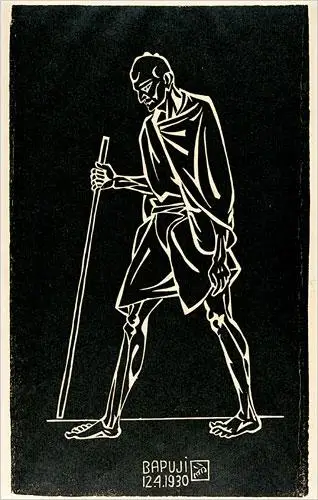
Bapuji (1930) is one of Nandalal Bose’s most famous works and an iconic image of Mahatma Gandhi. Created as a linocut print, the artwork depicts Gandhi walking with a staff during the historic Dandi March (Salt March) of 1930, a key event in India’s struggle for independence. Bose, who had a strong interest in sketching people and everyday life, captured Gandhi’s determination and simplicity through a few powerful lines.
The composition is remarkable for its economy of form. Using a dramatic contrast of black and white, Bose created a striking image that conveys movement, strength, and moral conviction. The simplicity of the design reflects Gandhi’s own ideals of humility and self-reliance. Rather than focusing on detailed realism, Bose emphasized the symbolic significance of Gandhi as a leader of the Indian freedom movement. Today, Bapuji remains one of the most recognizable images in modern Indian art and a powerful visual representation of India’s fight for independence.
Date: 1930
Subject: Mahatma Gandhi during the Dandi (Salt) March
Theme: Freedom, leadership, sacrifice, and non-violent resistance
Style: Linocut print; Modern Indian Art; Bengal School influence
References
- National Gallery of Modern Art (NGMA), New Delhi
https://www.ngmaindia.gov.in/virtual-tour-of-nandalal-bose.asp - Visva-Bharati University, Santiniketan
https://www.visvabharati.ac.in/NandalalBose.html - Lalit Kala Akademi
https://lalitkala.gov.in - Ministry of Culture, Government of India – Constitution of India Art and Heritage Resources
https://www.indiaculture.gov.in - Oxford Art Online – Nandalal Bose
https://www.oxfordartonline.com - Google Arts & Culture – Nandalal Bose Related Collections
https://artsandculture.google.com/entity/nandalal-bose/m0bsxtb?hl=en - Museums of India: National Portal & Digital Repository
https://museumsofindia.gov.in/repository/search/basic?searchterm=nandalal%20bose&museumId=all